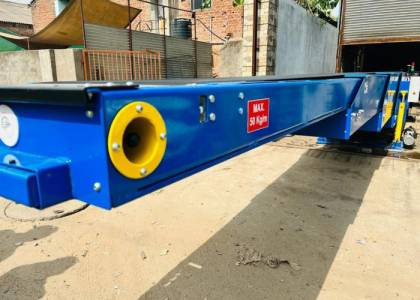
Description
Screw Conveyors: Efficient Material Handling Solutions
Screw conveyors, also known as auger conveyors or spiral conveyors, are highly versatile and efficient machines used for the conveying of a wide range of bulk materials. They offer a reliable and cost-effective solution for moving materials horizontally, inclined, or even vertically, making them ideal for various industries.
How They Work:
A screw conveyor consists of a helical screw blade (or flighting) rotating within a trough-shaped housing. As the screw rotates, driven by a motor and gearbox, it pushes the material along the trough. The design ensures gentle material handling, minimizing damage and degradation. The speed and pitch of the screw can be adjusted to optimize material flow and throughput for different applications.
Key Features and Benefits:
- Versatile Material Handling: Suitable for conveying a wide range of materials, including powders, granules, chips, flakes, and even small solids. Can handle abrasive, sticky, or delicate materials depending on the specific design and material of the screw and trough.
- Efficient and Reliable Operation: Offers high throughput rates with minimal downtime, leading to increased productivity and reduced operational costs.
- Gentle Material Handling: Reduces material degradation and damage compared to other conveying methods, preserving material quality.
- Compact Design: Occupies minimal floor space, making them suitable for applications with limited space.
- Customizable Designs: Available in various sizes, lengths, materials (stainless steel, carbon steel, etc.), and configurations to suit specific application requirements. Options include different screw designs (e.g., single, double, ribbon), trough materials, and sealing systems.
- Easy Maintenance: Modular design allows for easy access to components for inspection, cleaning, and maintenance, minimizing downtime.
- Precise Control: Variable speed drives allow for precise control over material flow rate.
- Safe Operation: Equipped with safety features such as emergency stops and safety guards to protect operators.
Applications:
Screw conveyors find widespread application across diverse industries, including:
- Agriculture: Grain handling, feed mixing, and fertilizer transport.
- Food Processing: Conveying ingredients, powders, and finished products.
- Chemical Processing: Handling powders, granules, and pellets.
- Mining: Moving crushed ore and other materials.
- Waste Management: Conveying waste materials.
- Manufacturing: Transporting small parts and components.
- Pharmaceutical: Gentle handling of sensitive pharmaceutical powders and granules.
Types of Screw Conveyors:
- Horizontal Screw Conveyors: Used for conveying materials horizontally.
- Inclined Screw Conveyors: Used for conveying materials at an incline.
- Vertical Screw Conveyors: Used for elevating materials vertically.
- Ribbon Screw Conveyors: Feature two or more helical blades to enhance mixing and conveying efficiency.
Choosing the Right Screw Conveyor:
Selecting the appropriate screw conveyor requires considering several factors, including:
- Material properties: Density, particle size, abrasiveness, stickiness, and moisture content.
- Throughput requirements: The desired conveying capacity.
- Conveying distance and inclination: The length and angle of the conveyor.
- Environmental conditions: Temperature, humidity, and potential exposure to corrosive materials.
- Space constraints: The available floor space for installation.
Contact us today to discuss your specific material handling needs and let our experts help you choose the ideal screw conveyor solution for your application. We offer a range of standard and custom-designed screw conveyors to meet your unique requirements.